
2. April 2026 | Portraits
The Art of Balance: A Portrait of the new IAB Vice Director Professor Melanie Arntz
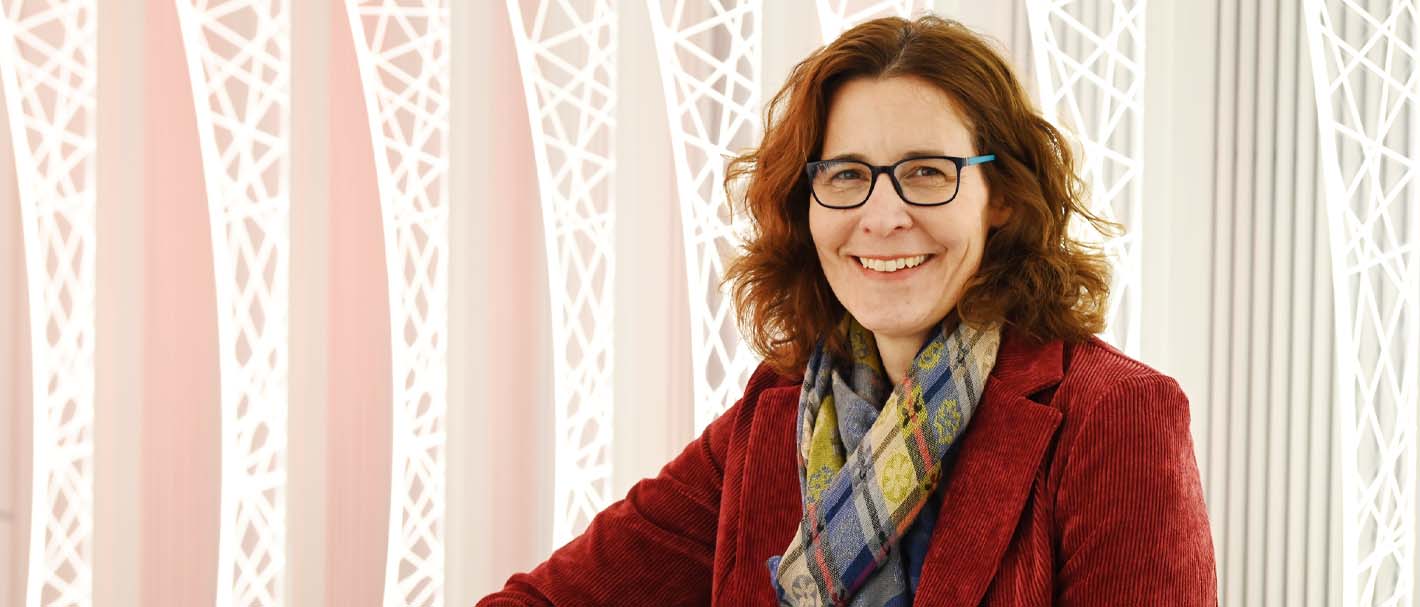
Melanie Arntz stands relaxed yet upright in her office, wearing jeans and a dark blue cotton jacket, her sleeves rolled up. It is after four in the afternoon and she has already worked her way through a long list of meetings, though you wouldn’t notice. Her gaze is curious; with a brief gesture she invites her visitor to take a seat and then gets straight down to the conversation.
Arntz has now been Vice Director of the Institute for Employment Research (IAB) for one year. Expectations were high from the outset. Some hoped she would step seamlessly into the role long filled for decades by widely respected networker Ulrich Walwei, while the Federal Employment Agency expected an adviser capable of representing the IAB confidently on high-level policy forums. Meanwhile, in-house researchers were hoping for an academic expert who would take the lead in driving forward new topics. Her first appearance at the Institute’s general assembly surprised everyone: approachable and pragmatic, she introduced herself and then offered all staff the option of being on first-name terms.
A year later, she remains an attentive conversational partner – knowledgeable, open-minded and someone who meets people on an equal footing.
Thirst for knowledge as a guiding principle
Born in Leverkusen in southern North Rhine-Westphalia and raised in a civil-servant family, Melanie Arntz describes her background as one in which education and discussions were valued. Even so, her curiosity about the world seems to have been there from the very beginning. She says that her deep interest in the world was something she was born with. Even as a child, she enjoyed watching “Auslandsjournal” and other documentaries. “I’ve always wanted to understand everything – not just individual people but the bigger picture, too,” says Arntz with a smile. “Even back then, simple answers were never enough for me.”
At 15 she visited the careers information centre at the Leverkusen employment office and clicked her interests into a simple computer programme. The career recommendation then appeared on the screen: professor. She still laughs about that today.
After finishing secondary school, she chose to do a degree in geography – the study of the relationships between human societies and their environments. But before long, this descriptive approach no longer satisfied her. “I wanted to find out more about what’s behind the structures.” A turning point for her was a year spent studying in the United States. On a public administration course she encountered a professor who worked empirically – using methods that seemed more compelling than anything else she’d seen up to then.
He handed her a dataset and an econometrics textbook and said: “This is Stata – go ahead.” Immersing herself in the project, she became a student assistant and went on to work with the professor on further empirical studies, including projects for the World Bank. “That’s when I really got the bug,” she says today. Her decision to pursue empirical economic research wasn’t the result of a carefully orchestrated plan, but grew out of her curiosity about the questions themselves – and this has stayed with her. After completing her degree in geography, she began her doctorate at the Centre for European Economic Research (ZEW) in Mannheim in 2002. As someone entering economic research from another discipline, Arntz initially felt she lacked enough theoretical grounding, so she started by attending econometrics lectures at the University of Mannheim. The professor teaching those courses at the time was Bernd Fitzenberger. She raises her eyebrows mischievously. “I had enormous respect for him back then.” She couldn’t then have imagined that years later they would jointly be leading the IAB in Nuremberg.
Once she had established herself at the ZEW, Arntz began to pursue the topics she was most interested in, namely regional labour markets and mobility. She wrote her own research funding proposals, sought out like-minded collaborators and built networks. “That’s when I realised that, with enough persistence, you can carve out a space of your own in academia.”
Arntz remained at the ZEW for more than two decades – an unusually long time in the academic world. But for her this didn’t mean standing still. She repeatedly sharpened her focus, taking on new responsibilities and delving into new areas of research. For a time she served as junior professor, later going on to become deputy head of the Labour Markets and Social Security research department. From 2018 onwards she also held a professorship in labour economics at the University of Heidelberg.
Throughout that time she combined her thirst for knowledge with a fundamental optimism. “Doors didn’t always open exactly when I was getting impatient for them to do so,” she says. But looking back, she realises that things often had a way of falling into place at the right moment. When the position of Vice Director at the IAB became vacant, she thought: “Now or never.”
Growth means taking on challenges – and setting limits
She was well aware that this step would involve major changes: a job that moved at a much faster pace, involved greater responsibility and above all gave her less control over her time.
Even so, she didn’t hesitate for a moment. In her purse she carries a piece of paper that has become rather worn over the years. A friend gave it to her when she was 19. It essentially says that we only grow through the things that challenge us. “Those words remind me to pursue what I’m passionate about, even when things get tough,” she says openly. “And I knew I was capable of doing the job.” She pauses briefly. “What concerned me most was the change in how I’d be able to manage my time.”
For the past year Arntz been commuting between Speyer in Rhineland-Palatinate and Nuremberg so as to strike a balance between work and family life. She works three days from home and two days in the office, with the week planned almost down to the minute. Aged 10 and 13, her daughters are looked after alternately by Arntz and their father. “Given such a tightly scheduled week, there’s no way I can suddenly add on ten extra hours of work.”
Her office reflects that reality. There are hardly any personal items and no decorations apart from two landscape photographs on the wall – showing a bridge and a ship. This is not a retreat, it’s a workspace – one she puts to efficient use. How does she manage not to feel constantly overwhelmed by such a workload?
She gives a shrug, her gaze shifting to the wide wall of windows. Outside, dusk is beginning to settle over the rooftops. “Sometimes things simply have to wait,” she says. Then she explains that after this interview, she’ll have to decide – as she does every Thursday evening – whether to deal with a few more e-mails or call it a day and drive the two hundred kilometres to Speyer in time to swim a few lengths at the pool.
“For me, working effectively also means maintaining a balance,”she says. “As a leader I want to set an example.” Setting boundaries is not a sign of weakness, she says: it reflects a sense of responsibility. Anyone who constantly overextends themselves harms not only their own well-being but also that of the people around them. She’s also well aware of the more negative sides of the international academic system: growing competition, insecure career paths and the question of how inclusive a system can really be when it demands maximum flexibility. “Only a bad employer runs people into the ground,” she says matter-of-factly. “I believe the vast majority of people here at the IAB are highly motivated in their research. That’s precisely why we have to take good care of them – and sometimes that means taking “no” for an answer.”
Collaboration is always based on confidence and trust, says Arntz: for her, these are the two factors that define leadership. Micromanagement is not her style. Instead she believes in teamwork, allowing room for initiative and shared responsibility.
What she particularly values at the IAB are the constructive and often critical discussions with the many bright minds at the Institute. “That’s often when the best ideas emerge,” she says. But she believes leadership also means making decisions that not everyone will like.
She admits that this part is not always easy for her – particularly in working with the Institute’s middle management. Learning to tolerate disagreement was something she had to adjust to during her first months in the role. “As someone who seeks balance,” she says, “I’d ideally like to get everyone on board based on motivation and example.” But that’s not always the way things work. And compromise is not automatically the better solution either, she adds. What does matter to her is that staff should at least be able to see the reasoning behind a leadership decision.
Research with a view to reality
Despite her management responsibilities, Arntz is keen to remain an active researcher. Research is not a luxury for her, she says: it’s the foundation that keeps her connected to the core mission of the IAB. “And besides, I simply enjoy it enormously.” She blocks time for research in her calendar whenever possible.
Her research interests reflect her general outlook: she doesn’t choose them based on prospects of quick publication or good rankings, but according to societal relevance. “I’d rather work on something that matters than on something that’s only rewarded academically.” For her, the crucial question is what her research can contribute – to the advancement of knowledge, to policy debate and above all to the people whose working lives she studies.
Her current focus is on digitalisation and artificial intelligence and the concrete impact they’re having at the workplace. Last year she conducted a large-scale survey on AI-supported work, together with colleagues at the IAB, the ZEW and the German Federal Institute for Occupational Safety and Health. “Who is already using AI in their job and under what conditions? And how is it already impacting employment opportunities?” she says. In her current projects she’s investigating whether new technologies reinforce existing inequalities or create new ones. Who is benefiting and who is under pressure? She sees qualifications, work experience and age as being particularly important factors.
Arntz has assembled a dedicated team to pursue these projects. “In the past few months we’ve hired two or three new colleagues – now the team is finally complete,” she says. One thing they’re doing is to prepare a survey of firms that is scheduled to take place this year. The aim is to trace developments both at firm-level and among employees over the past five years – a period that has seen rapid changes in the use of digital technologies. “Only then will we be able to explore the questions in depth and link the data to administrative information.” Her impatience is plain to see.
“I always want results faster than the process allows,” she says with a laugh, adding that a high tolerance for frustration is essential in research. “You develop ideas, immerse yourself in new projects – and then reality catches up with you and everything takes six months longer.”
Could artificial intelligence accelerate research itself?
“It’s impossible to generalise,” she explains: after all, as new technological possibilities emerge, the expectations of research increase as well. She uses AI as a sounding board herself, she says – to refine a line of reasoning or test a counter-argument. As she sees it, the main risks arise where methodological foundations are lacking. “If you haven’t yet mastered the craft of research and then let AI loose on it, things can go badly wrong.”
AI can support research, help with decisions and open up new perspectives, she says, but responsibility and judgement remain human tasks. “AI will not replace thinking.”
A place for creative development
And a great deal of thinking goes on at the IAB – something she particularly appreciates about the Institute. Her vision for the future of the organisation is clear: she wants an organisation that is high-performing but never rigid. “A living, breathing structure,” as she calls it. “I’d be delighted if, in ten years’ time, people looking at us from the outside will be saying, even more than now: this is a dynamic research environment where people truly flourish.” A place where that thirst for knowledge she’s always felt herself is not restrained but harnessed.
She’s aware that science today faces increasing pressure to justify itself. And precisely for that reason, she believes it’s crucial to demonstrate relevance without focusing solely on immediate utility. “We need both,” she says, glancing around her office. “We need to be closely linked to policy-making, yet at the same time free and creative.” Research should neither be an ivory tower nor a purely service-driven activity, she says.
At the Institute itself, she feels that people sometimes focus too much on problems and constraints. “Of course not everything works out immediately the way you’d like it to.” Structures are often there for a good reason, standardisation is necessary, and exceptions are not always possible at a public institution. “I’d like people here to focus a bit more often on what we’ve already accomplished. The glass is half full, and I genuinely welcome everyone’s ideas,” she says with a smile.
After a year in office, perhaps this is the essence of her approach at the IAB: positive communication, a spirit of curiosity and the courage to remain authentic. That’s another reason why she offered to be on first-name terms with all the staff at the IAB.
She stands up: it’s dark outside, and there are only a few offices left where the lights are still on. The interview is over – and her decision is made: she’s going to set off on the long drive to Speyer right away so there’ll be time for a swim this evening. Her way of restoring the balance after another intense day of work.
DOI: 10.48720/IAB.FOO.20260402.01
This publication is published under the following Creative Commons Licence: Attribution – ShareAlike 4.0 International (CC BY-SA 4.0):
https://creativecommons.org/licenses/by-sa/4.0/deed.de
Keitel, Christiane (2026): The Art of Balance: A Portrait of the new IAB Vice Director Professor Melanie Arntz, In: IAB-Forum 2nd of April 2026, https://iab-forum.de/en/the-art-of-balance-a-portrait-of-the-new-iab-vice-director-professor-melanie-arntz/, Retrieved: 1st of October 2026
Diese Publikation ist unter folgender Creative-Commons-Lizenz veröffentlicht: Namensnennung – Weitergabe unter gleichen Bedingungen 4.0 International (CC BY-SA 4.0): https://creativecommons.org/licenses/by-sa/4.0/deed.de

Authors:
- Christiane Keitel