
24. April 2026 | Establishments and the Demand for Personnel
Trump’s trade policy: almost every fifth establishment in the manufacturing sector feels the consequences
On the first day of his second term in office, President Donald Trump announced the new principles of US trade policy in the memorandum “America First Trade Policy”, officially seeking to reduce large trade deficits with other countries. The United States initially imposed new import tariffs on Canada, Mexico and China at the beginning of last year, and all three countries responded with corresponding countermeasures. Additional tariffs were imposed on imports of steel and aluminium in March.
Logistics was also affected by protectionist measures taken by the US administration, with increasing port fees for Chinese ships. At the beginning of the second quarter of 2025, the United States further intensified the tariff conflict by introducing tariffs of at least 10 percent on almost all imports, including those from the European Union. A separate tariff rate of 25 percent was being applied to cars, car parts, aluminium and steel from the European Union (EU). In June, the United States increased tariffs on steel and aluminium from all countries, except from the United Kingdom, to 50 percent. In August, tariffs on most goods from the EU were raised to 15 percent, while those on cars and car parts were reduced to 15 percent. Exemptions apply to pharmaceutical products, aircraft and aircraft parts, but tariffs on steel and aluminium and related products remained unchanged at 50 percent.
Within a very short period, there were some dramatic tariff increases on a broad scale, affecting almost all countries to varying degrees. This is historically unprecedented for the post-war period. These changes along with other announcements of new tariffs, some of which were later amended or withdrawn, have created a highly uncertain economic environment that is placing severe strain on businesses’ ability to plan.
On 20 February 2026, the US Supreme Court ruled that the introduction of higher tariffs based on the International Emergency Economic Powers Act (IEEPA) was not in the US president’s authority, since it would have required congressional approval. Yet the US government continues to adhere to its rigorous tariff policy in order to reduce what it regards as an unjustified trade deficit. Whether or not this objective can actually be achieved in the long term is questionable.
The US is after China the most important trade partner of Germany
According to the Federal Statistical Office, the USA was the most important destination for German exports in 2024. The value of these exports was 146.2 billion euros, however – around 9.4 percent lower than in the previous year. Measured in terms of total foreign trade, i.e. the sum of exports and imports, the United States is Germany’s second most important trading partner after China. In a recently published article for IAB-Forum, Ute Leber and others show that the economic situation remains particularly challenging, especially for businesses exporting to the United States.
In view of the potential impact on the German labour market, establishments were surveyed as part of the IAB Job Vacancy Survey on the extent to which they are directly or indirectly affected by the consequences of US tariff policy. In the third quarter of 2025, establishments were first asked whether they had generated part of their revenue abroad in 2024 and whether and how they are affected by the new US trade policy or by retaliatory measures taken by other countries since January 2025.
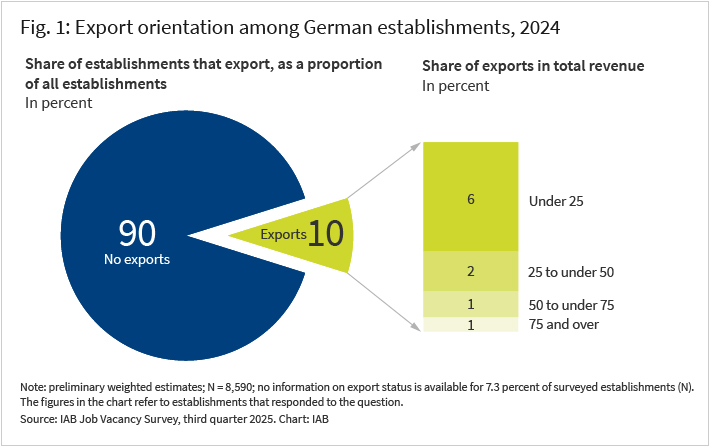
According to the survey, around 10 percent of establishments generated part of their revenue abroad in 2024, with 2 percent reporting an export share of more than 50 percent (see Figure 1). Exporting businesses are naturally more affected by US trade policy than non-exporting ones. But even the latter are not necessarily immune, since they may supply businesses that in turn export to the United States.
Around 4.7 million people work in establishments that are predominantly negatively affected
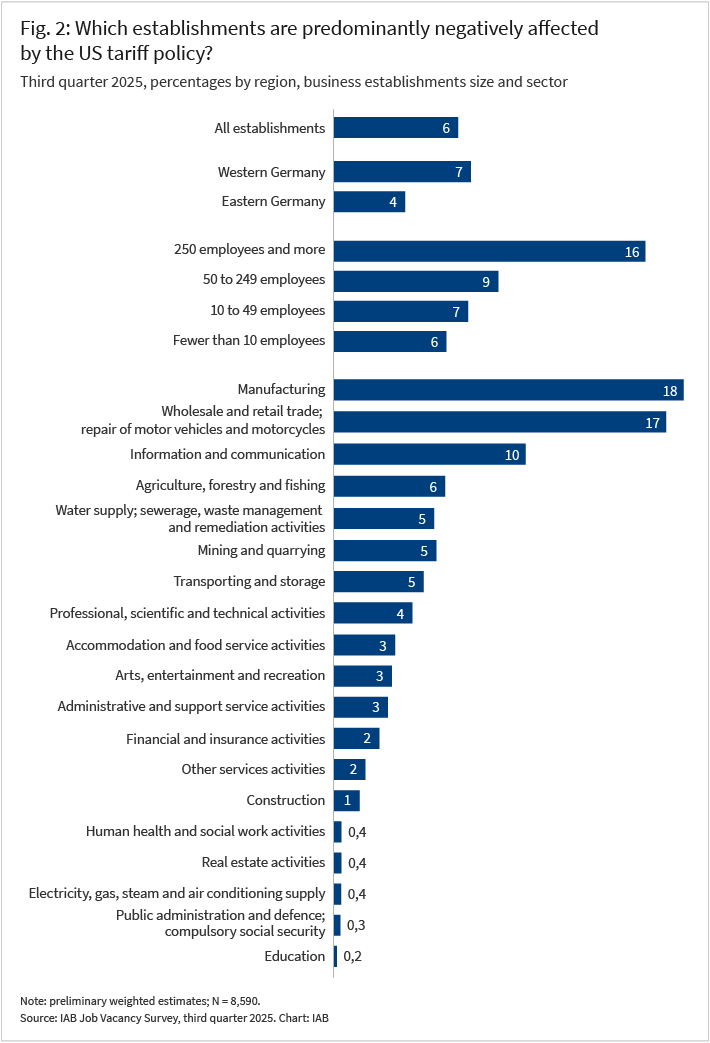
According to the IAB Job Vacancy Survey, around 6 percent of establishments report that they have been predominantly negatively affected by the new US trade policy since January 2025, or by counter-tariffs imposed by other countries (see Figure 2). These establishments employ around 4.7 million people, equivalent to 11 percent of the total number of employed people in Germany.
Businesses with more than 250 employees are disproportionately affected, at 16 percent. The same applies to businesses in manufacturing (18 percent) and in the “wholesale and retail trade; repair of motor vehicles and motorcycles” sector (17 percent). Meanwhile, the share of businesses predominantly negatively affected by US tariffs is significantly lower in eastern Germany than in western Germany, partly reflecting differences in export orientation (4 versus 7 percent).
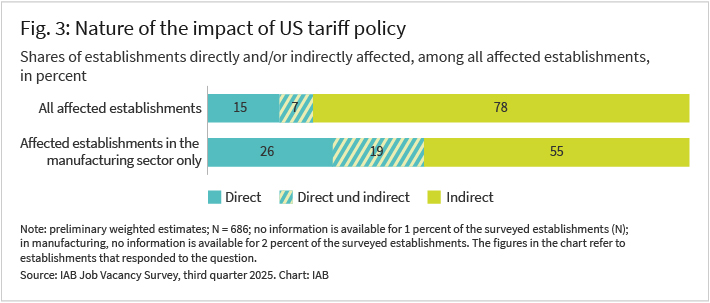
Finally, another finding from the IAB Job Vacancy Survey is that far more establishments are indirectly affected than directly affected. Of the establishments predominantly negatively affected by US tariff policy, 15 percent report direct effects (see Figure 3), 7 percent report both direct and indirect effects, and 78 percent stated that they were only indirectly affected.
Looking only at direct exports significantly understates the true impact on the economy and, ultimately, the labour market. For example, indirect effects may arise as a result of supply relationships with an establishment based in Germany or in another country that exports to the United States.
Based on the current data available, only very limited conclusions can be drawn regarding the impact of US tariff policy on the labour market. Although job vacancy numbers tend to reflect changes in the economic situation fairly quickly, the very short observation period offers only limited analytical insight.
The fact is that the number of job vacancies in the establishments under consideration here fell sharply between the fourth quarter of 2024 – immediately before the tariff adjustments – and the third quarter of 2025, declining from 121,000 to around 94,000, a drop of around 22 percent. Nonetheless, it remains unclear to what extent this was due to increasing difficulties in export business. With total job vacancies decreasing by more than 26 percent over the same period, from around 1.40 million to 1.03 million, it would appear that the effect of US tariff policy alone has not yet had a major impact on the labour market.
Tariff barriers put pressure on establishments and heighten labour market uncertainty
Clearly, the sharp decline in job vacancies in recent years is due to a range of factors that operate independently of US tariff policy and outweigh its effect. This applies also to establishments exporting to the United States. The German labour market is undergoing a profound transformation, as described by Nicole Gürtzgen, Alexander Kubis and Martin Popp in IAB-Monitor Labour Demand 4/2025 .
In addition to a likely stagnating labour force, the labour market is deeply impacted by digitalisation and decarbonisation. Businesses also tend to scale back their recruitment activity in general during periods of economic weakness, as observed in 2025: the number of job vacancies has almost halved compared with its peak of around 2 million in the fourth quarter of 2022 (on this point, see a recent analysis of the IAB Job Vacancy Survey by Alexander Kubis).
In this environment, the sometimes erratic introduction of new US tariffs not only increases the cost of trade, it also heightens uncertainty for businesses. Faced with this lack of planning certainty, many companies focus on their core activities and may refrain from pursuing new projects. In an article published in Makronom, Enzo Weber has described this more broadly as a “crisis of renewal”. Given the multiple factors involved, it remains difficult to clearly identify the specific effects of changes in US tariff policy on the German labour market.
Conclusion
The United States is a key German trading partner and will remain so in the years ahead. This means that stable, partnership-based trade relations are in the interest of both sides. It remains to be seen to what extent US tariff policy will leave a mark on the German labour market. In order to limit its impact, a convincing European response is required to the aggressive tariff policy of the US administration. What is needed is a unified and determined stance on the part of the EU along with the full use of opportunities arising from its own economic strength. The EU should intensify its efforts to conclude or expand trade agreements with other partners.
In brief
- 10 percent of the establishments that provided information on their revenue generated part of it abroad in 2024.
- In the third quarter of 2025, around 6 percent of establishments reported that they were predominantly negatively affected by US trade policy. This share was 18 percent in the manufacturing sector and 17 percent in the wholesale and retail trade sector.
- The predominantly negatively affected establishments employ about 4.7 million people – approximately 11 percent of the total number of employed people in Germany.
Literature
Gürtzgen, Nicole; Kubis, Alexander; Popp, Martin (2026): IAB-Monitor Labour Demand 4/2025: Die Zahl der offenen Stellen konsolidiert sich auf niedrigerem Niveau, In: IAB-Forum, 12 March 2026.
Kubis, Alexander (2026): IAB Job Vacancy Survey 4/2025: Zahl der offenen Stellen steigt von 1,03 auf 1,26 Millionen – und damit stärker als saisonüblich. In: IAB-Forum, 05 March 2026.
Leber, Ute; Oberfichtner, Michael; Schwengler, Barbara (2026): Die wirtschaftliche Lage der Betriebe in Deutschland ist weiterhin angespannt, in: IAB-Forum, 11 January 2026.
Weber, Enzo (2025): Die Erneuerungskrise, in: Makronom, 6 October 2025.
The IAB Job Vacancy Survey
The IAB Job Vacancy Survey is carried out four times a year to study the supply of vacancies for the entire job market and includes those vacancies that are not reported to the employment agencies. In the follow-up survey in the third quarter of 2025, 8,590 establishments with employees subject to social security contributions were surveyed. In addition to collecting core information on the German labour market, part of the questionnaire in the third quarter of 2025 also addressed the impact of the changes to US tariff policy introduced in January 2025 on German establishments.
The data from the IAB Job Vacancy Survey consists of weighted estimates based on a sample and is therefore subject to a certain degree of statistical uncertainty. When interpreting the data, it is important to bear in mind that some changes in the figures may fall within the margin of sampling error. The smaller the subsample, the greater the degree of uncertainty.
For current figures on the (long-term) development of job vacancies and other variables based on the IAB Job Vacancy Survey, see the IAB website. The updated edition of the IAB-Monitor Labour Demand 4/2025 is available on the IAB-Forum.
DOI: 10.48720/IAB.FOO.20260424.01
This publication is published under the following Creative Commons Licence: Attribution – ShareAlike 4.0 International (CC BY-SA 4.0):
https://creativecommons.org/licenses/by-sa/4.0/deed.de
Stepanok, Ignat; Kubis, Alexander (2026): Trump’s trade policy: almost every fifth establishment in the manufacturing sector feels the consequences, In: IAB-Forum 24th of April 2026, https://iab-forum.de/en/trumps-trade-policy-almost-every-fifth-establishment-in-the-manufacturing-sector-feels-the-consequences/, Retrieved: 25th of October 2026
Diese Publikation ist unter folgender Creative-Commons-Lizenz veröffentlicht: Namensnennung – Weitergabe unter gleichen Bedingungen 4.0 International (CC BY-SA 4.0): https://creativecommons.org/licenses/by-sa/4.0/deed.de


Authors:
- Ignat Stepanok
- Alexander Kubis