
9. September 2026 | Series "Covid-19 crisis: consequences for the labour market"
How working from home is reshaping Germany’s commuting and residential landscapes
Sena Coskun , Wolfgang Dauth , Hermann Gartner , Michael Stops , Enzo Weber

The shift to working from home
The Covid-19 pandemic triggered a fundamental structural shift in the German labour market, transforming working from home (WFH) from a niche phenomenon into a widespread norm. While initially a response to a crisis, remote work has endured long after the immediate effects of the pandemic subsided. Data from the German national statistics office, Destatis, and the Ifo Institute indicate that a significant share of the workforce continues to work remotely on a regular basis, while the IAB’s establishment surveys confirm that a large proportion of firms have made this option the norm.
This ‘new normal’ is predominantly characterised by hybrid models, where employees split their time between working from home and at the workplace. By uncoupling professional duties from a designated location for part of the week, the traditional cost-benefit calculation of the daily commute alters. In this analysis, the spatial implications of this trend are investigated, including the question of whether the rise of WFH is leading to longer commuting distances ⎼ and thus to a decoupling of workplace and residence.
Commutes are getting longer
Since 2020, the distance between home and workplace has steadily increased, especially for people in jobs that can easily be done from home. Figure 1 shows how the average distance between home and the workplace of office workers has increased from 27.5 km before the pandemic to 32 km at the end of 2023.

The role of “Home-office potential”
The option to work from home is a key factor in this changing commuting pattern. This was shown in a 2026 publication by the authors of the underlying article. This work is based on extensive German administrative data and uses an indicator for the potential of an occupation to be performed remotely (home-office potential, HOP), which was developed by Franziska Bruns and co-authors.
For the presentation in Figure 2 we classify the half of the employees in occupations with the lowest home-office potential as the low-home-office-potential group, such as construction workers. The quarter of employees with the highest potential constitute the top group. The group with medium potential lies in between.
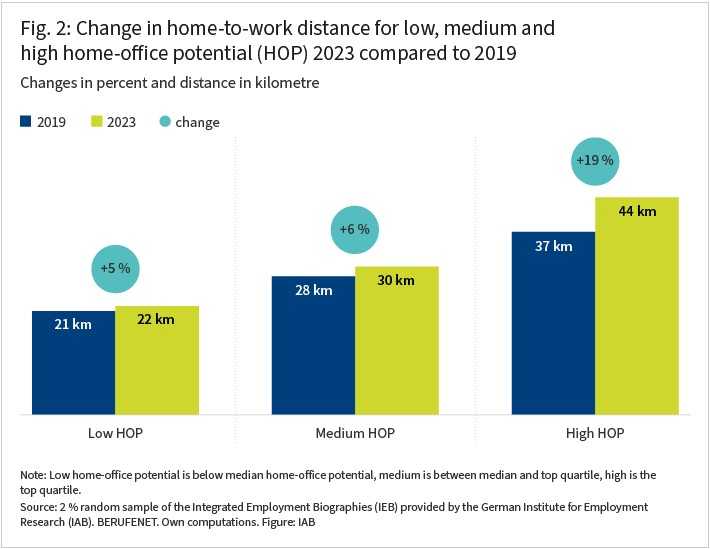
Between 2019 and 2023, the average distance to work for employees with high potential for remote work increased by 19 percent, while for employees with low and medium potential, it increased by only 5 to 6 percent. Distances increased only slightly for workers who carry out a substantial share of their tasks in their designated workplace. By contrast, for the group of occupations that strongly lend themselves to remote work, distances increased substantially. This result suggests a significant behavioural shift in residential- and job-related decision-making, driven primarily by employees who have the option to work remotely.
What’s behind increasing distances between home and work?
As already described, the average home-to-work distance has increased more strongly in occupations amenable to remote working. Now, the drivers behind this increase are examined: is it home relocation, job changes, or both?
Between 2019 and 2023, the average work-home distance in Germany increased by almost 3 kilometres (from 26.5 to 29.5 kms), as Table 1 shows. This trend is driven by two key behaviours: employees moving to a new house, and employees switching to a new job.
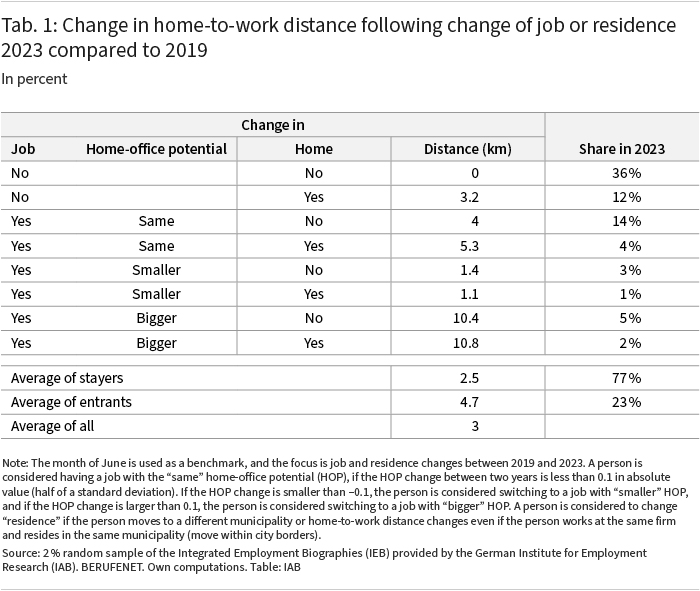
A significant number of workers are using the option of remote work as an opportunity to relocate. In 2023, 12 percent of employees kept their jobs from 2019 but moved house. On average, these movers live 3 km further away from their workplace than before.
Among the 29 percent of employees who changed jobs in this period, the increase of the distances was even larger. Table 1 differentiates between whether the new job’s home-office potential changed and whether employees moved their home location during the same period: 7 percent of employees switched to a new job with greater potential for working from home (2 % moved their residence at the same time and 5 % stayed). For these 7 percent, the average work-home distance shot up by a remarkable 10 kilometres. This suggests that workers are confidently accepting better jobs further away, knowing that remote work makes the longer distance manageable.

Working from home and housing costs
The residential and workplace choices that are made possible by working from home are causing a shift away from living in big cities. The data show that since the pandemic, people in jobs with the option to work remotely are less likely to live in major cities and instead reside in the surrounding area.
This trend is directly linked to the cost of housing. Remote work allows employees to avoid high urban rents without giving up well-paid city jobs. In Figure 3, the rent prices in work- and home-locations for people with low, medium, and high home-office potential are shown. For workers in jobs which are remote-work-compatible, the difference in rental prices between their workplace and their home has grown significantly. Jobs that allow remote work (high HOP) are increasingly concentrated in high-rent areas, while the employees who hold these jobs reside in areas where the rent prices remain on average the same. In short: people are increasingly taking jobs in expensive metropolitan hubs while living in more affordable suburban or rural areas.
Interestingly, the analysis found no significant difference in how these trends have affected the commuting patterns of men and women.
Conclusion
This analysis confirms that the rise of remote work has triggered a lasting change in the spatial scale of labour markets in Germany. The observed increase in commuting distances is not merely a temporary fluctuation, but the result of a deliberate behavioural shift among workers with high remote-working potential. By accepting significantly longer commutes — often when switching to new employers — these workers are effectively engaging in geographic arbitrage: securing high-paying metropolitan jobs while residing in more affordable suburban or rural areas. For the future of work, this implies a redefinition of local labour markets. Employers can now successfully recruit talent from regions well beyond traditional commuting belts, knowing that distance is less of a barrier when daily attendance is not required. Conversely, employees are no longer tethered to the high living costs of city centres. As hybrid models continue to embed themselves, this decoupling of work and residence suggests a future where economic activity remains concentrated in urban hubs, but the residential footprint of the workforce becomes increasingly dispersed.
In Brief:
- Commutes are getting longer: Since 2019, the average commute for office workers has increased from 27.5 to 32 kilometres.
- Remote working is the driver: The average distances for jobs with high home-office potential grew by 19 percent, compared to only 5–6 percent for jobs requiring on-site presence.
- Job-switches are increasing the distances: Workers switching to new jobs where they could work from home accepted commutes that were on average 10 kilometres
- Avoiding high rents: Workers are increasingly taking jobs with high remote-working potential in expensive cities but living in areas with lower rents, effectively decoupling their wages from local housing costs.
Info Box: Data and methods
- To measure commuting patterns accurately, administrative data covering approximately 11,000 municipalities across Germany were analysed. Rather than relying on broad regional estimates, this dataset made it possible to use precise geographic coordinates to calculate the direct distance—”as the crow flies”—between an employee’s home and their workplace. For the small number of commutes exceeding 200 kilometres, the measurement was standardised by calculating the distance between the centres of the respective municipalities.
- Data on rental prices are based on Mense et al. (2023).
- The home-office potential (HOP) indicator at the German 5-digit occupational classification (KldB 2010) is based on Bruns et (2026).
References
Bruns, F., Matthes, B., and Stops, M. (2026). HOP – an occupational indicator for the potential of working from home. Journal of Economics and Statistics. Vol. 246, No. 3, S. 261-280.
Coskun, S., Dauth, W., Gartner, H., Stops, M., and Weber, E. (2026). Working from home increases work-home distances. Journal of Urban Economics, Vol. 152, No. 103832.
Mense, A., Michelsen, C., and Kholodilin, K. A. (2023). Rent control, market segmentation, and misallocation: Causal evidence from a large-scale policy intervention. Journal of Urban Economics, Vol. 134, No. 103513.
Picture: IRStone/stock.adobe.com
DOI: 10.48720/IAB.FOO.20260909.02
Coskun, Sena; Dauth, Wolfgang; Gartner, Hermann; Stops, Michael; Weber, Enzo (2026): How working from home is reshaping Germany’s commuting and residential landscapes, In: IAB-Forum 9th of September 2026, https://iab-forum.de/en/how-working-from-home-is-reshaping-germanys-commuting-and-residential-landscapes/, Retrieved: 20th of October 2026
Diese Publikation ist unter folgender Creative-Commons-Lizenz veröffentlicht: Namensnennung – Weitergabe unter gleichen Bedingungen 4.0 International (CC BY-SA 4.0): https://creativecommons.org/licenses/by-sa/4.0/deed.de



Authors:
- Sena Coskun
- Wolfgang Dauth
- Hermann Gartner
- Michael Stops
- Enzo Weber