
27. April 2026 | Labour Market, Employment and Social Policy
App-based delivery services in Germany: Why people take up gig-work and usually quit quickly
Martin Friedrich , Ines Helm , Ramona Jost , Julia Lang , Christoph Müller

In Germany, app-based delivery services are a relatively new but increasingly important phenomenon. During the COVID-19 pandemic in particular, there was a sharp increase in employment in this sector, as Martin Friedrich and others demonstrate in an IAB Forum article from 2024.
At the same time, gig-work is a subject of controversial public debate. Delivery-service platforms (see the Information Box “Digital Platform Work”) repeatedly make headlines due to poor working conditions. And yet, the flexible working hours can also offer advantages. So far, there has been little research on why people take up employment as gig-workers with app-based delivery services – and why they end it relatively quickly. A new survey by the IAB (see the Information Box “Data and Methods”) provides answers.
In order to provide a comparison group to gig-workers in delivery services, a group of low-skilled workers was also surveyed. This group consists of all employees in cities where gig-workers also work and who, according to the Federal Employment Agency’s occupational classification, perform low-skilled work. Low-skilled jobs can be learned quickly because they do not require specialised knowledge. They therefore offer a similar level of low-threshold access to the labour market to that of gig-worker jobs in delivery services.
For the majority of delivery service workers, gig-work is a secondary activity
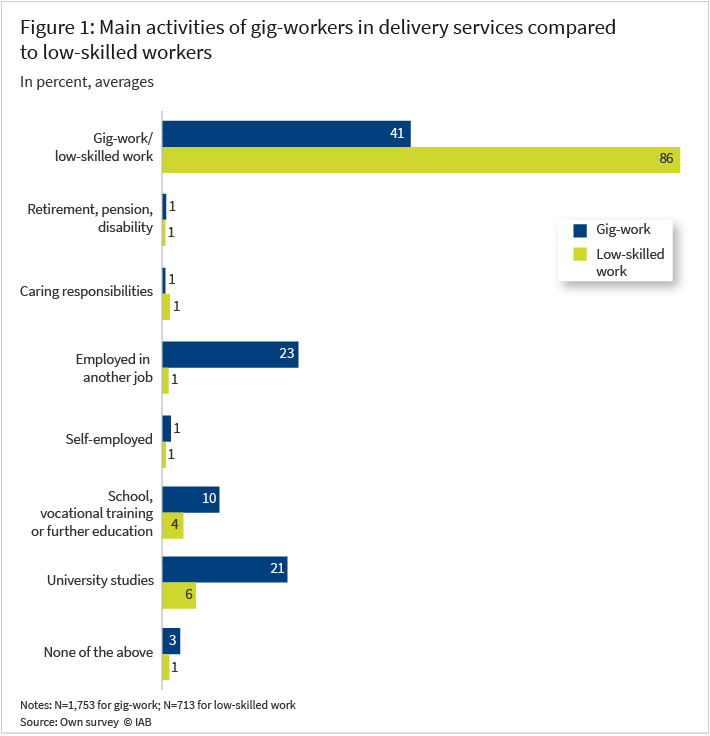
In the survey, employees were first asked about their main activity. 41 percent of gig-workers at delivery services stated that their job on the respective digital work-platform was their main activity (see Figure 1). 23 percent of gig-workers primarily work in another job, and a total of 31 percent are mainly engaged in educational activities (school, vocational training, university studies, or further education) and perform gig-work on the side.
In the comparison group of low-skilled workers, the vast majority (86 percent) stated that their low-skilled job was their main activity. Other activities play only a minor role in this group.
Ease of access, flexibility, and the possibility of additional earnings are important reasons for gig-work
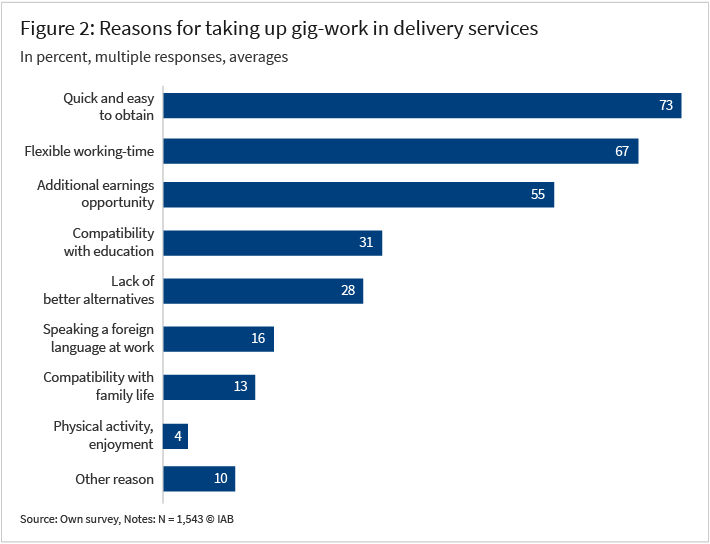
So why did respondents take a job as a gig-worker with a delivery service? The most frequently cited reasons (see Figure 2) were quick and easy access to these jobs (73 percent), the high degree of working-hour flexibility (67 percent), and the desire for an additional income opportunity (55 percent). Just over 30 percent of delivery service gig-workers stated that they do this work because it is compatible with educational activities.
Delivery service gig-workers are therefore generally people looking for a readily available and flexible way to earn extra income. In addition, 16 percent of gig-workers mentioned the opportunity to speak a foreign language at work. 28 percent cited a lack of better alternatives as a reason. This suggests specific barriers for gig-workers to take on other jobs.
More than half of job terminations were due to gig-workers quitting
Gig-work in delivery services is comparatively short-lived. In the forum article mentioned above, the authors conclude that, on average, only about one in five gig-workers holds the job for more than a year. Within the comparison group of low-skilled workers, the likelihood of remaining in the respective job for more than a year is almost twice as high. But why is gig-work so short-lived? And do gig-workers in delivery services tend to leave voluntarily or are they dismissed?
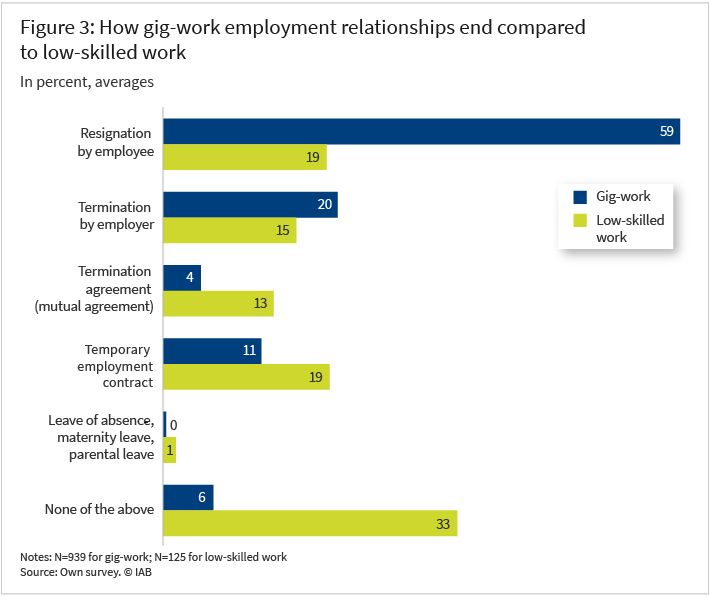
Figure 3 shows that, at 59 percent, most gig-workers resigned of their own accord. This is significantly more common than for low-skilled workers (19 percent). However, dismissals by employers are also somewhat more frequent among gig-workers. In contrast, terminations of gig-workers’ contracts through a mutual termination agreement, because the work was temporary or for other reasons like retirement is less frequent than in the comparison group.
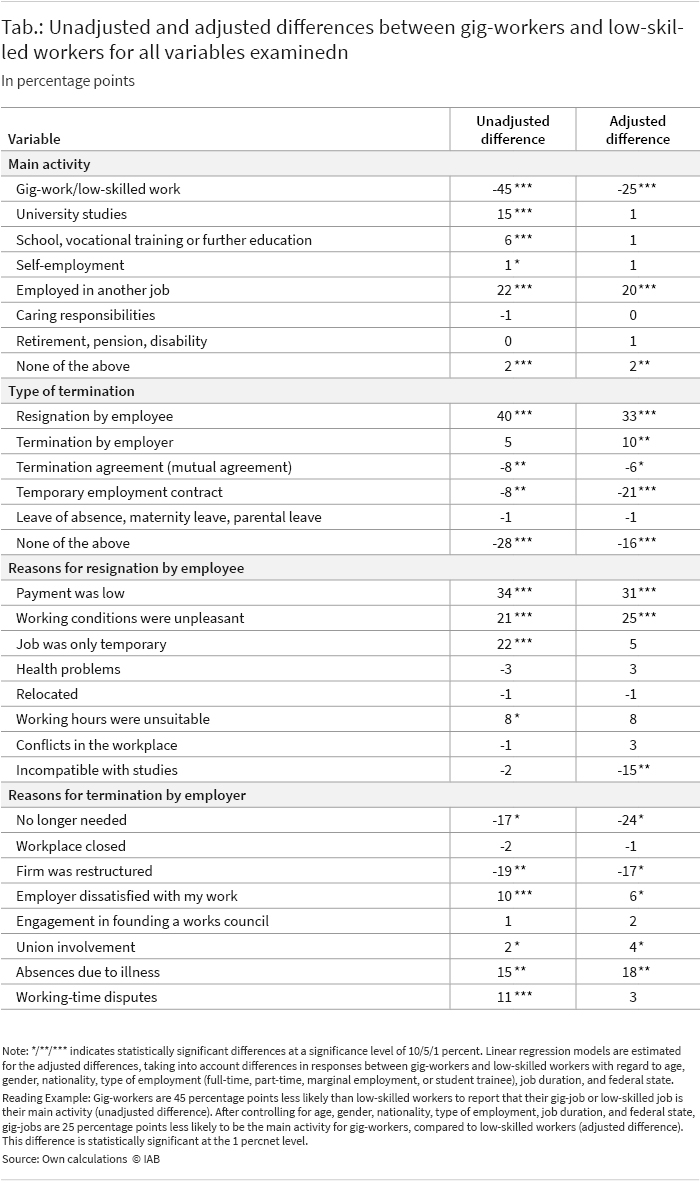
According to further findings of the analysis published in the IAB Forum in 2024, gig-workers in delivery services differ in their socioeconomic characteristics from employees in the comparison group. For example, they are younger, more frequently hold foreign citizenship, and are more often in part-time and marginal employment. Therefore, for all variables examined, an adjusted difference between the responses of gig-workers and low-skilled workers is calculated. This adjustment controls for differences between the two groups with regard to age, gender, nationality, type of employment, job duration, and federal state. The adjusted difference is thus more likely attributable to gig-work itself than to the specific socioeconomic characteristics of the gig-workers. The differences in the reasons for job terminations between gig-workers and low-skilled workers largely persist, even when controlling for socioeconomic characteristics (see Table).
Low pay and unpleasant working conditions are important reasons why gig-workers resign
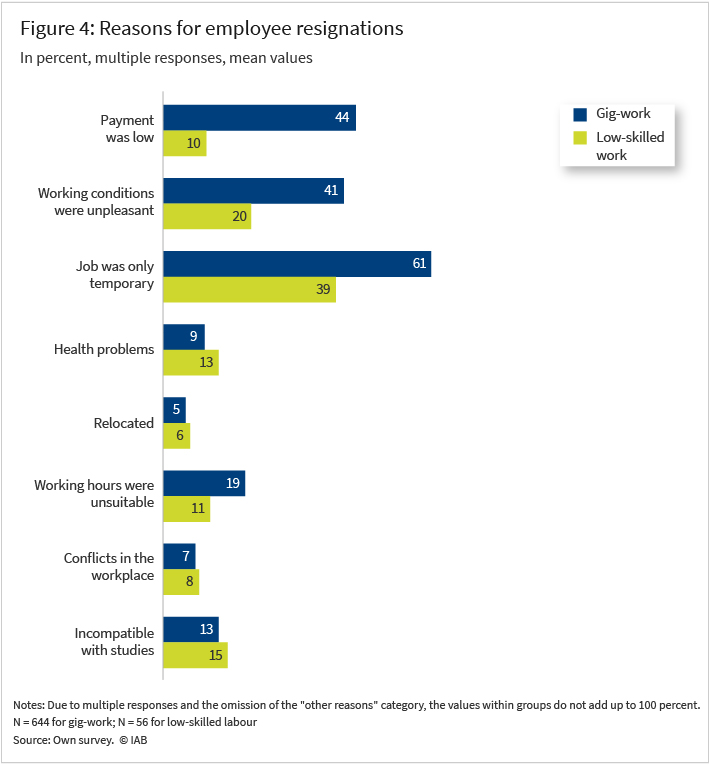
Why do gig-workers quit so frequently? 61 percent of those who quit state that the job was only intended as a temporary job (see Figure 4). This is also the most frequently cited reason among those in the comparison group who resigned. However, significant differences emerge, particularly regarding low pay and poor working conditions as reasons for leaving: gig-workers cite these reasons far more often than low-skilled workers.
By contrast, gig-workers cite incompatibility with their studies less frequently as a reason for leaving. This difference becomes especially apparent when considering socioeconomic differences between the two groups (see Table). This suggests that gig-work in delivery services offers a high degree of flexibility, which is particularly advantageous for students.
Gig-workers and low-skilled workers give different reasons for being laid off
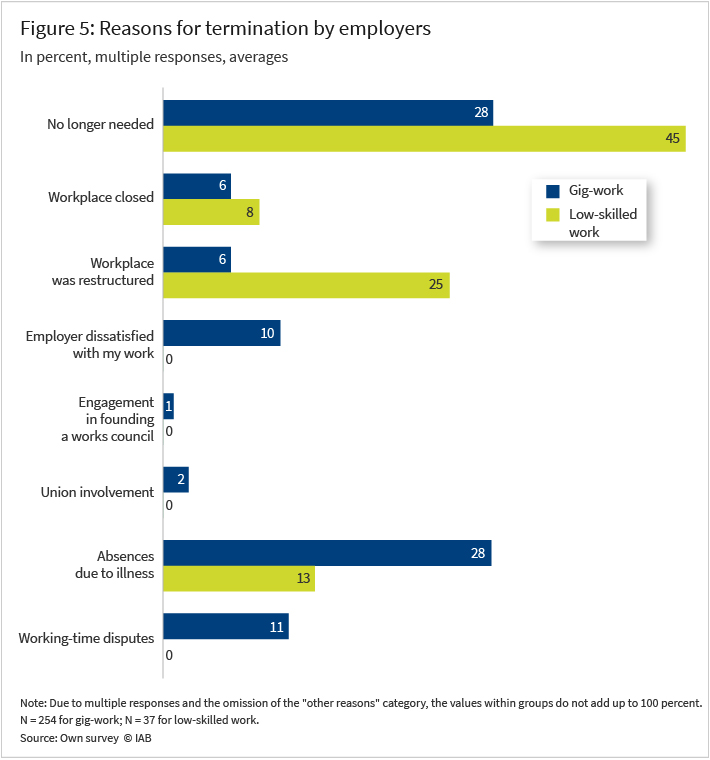
Approximately one in five of the surveyed gig-workers who ended their employment were dismissed by their employer. Figure 5 shows that the reasons given by gig-workers and low-skilled workers for their dismissal also differ significantly. It is striking that company-related reasons such as restructuring and declining demand for labour play a considerably larger role in the dismissal of low-skilled workers.
Gig-workers, on the other hand, report dismissal relatively frequently due to sickness-related absences. Furthermore, approximately one in ten workers dismissed from a delivery-service platform stated that their employer was dissatisfied with their performance or that there were conflicts regarding working hours. These reasons for dismissal were never mentioned by the 37 low-skilled workers surveyed.
These findings could indicate that there is greater performance pressure in the gig-economy and that performance can be more easily monitored by employers. It is also noteworthy that some gig-workers report having been dismissed because of their involvement with a works council or a trade union.
When interpreting this data, it is important to consider that the survey results reflect only the employees’ perspective. The (platform) companies’ view of the reasons for dismissal may differ. Furthermore, the sample size of the surveyed low-skilled workers who were dismissed by their employer is relatively small, at just 37 individuals. Based on this sample size, it cannot be ruled out with high statistical certainty that rare reasons for dismissal, such as involvement in a works council or trade union, are just as likely in the low-skilled worker group as in the gig-worker group.
Working-time disputes are cited as a reason for dismissal only in the gig-worker group. However, when differences in socioeconomic characteristics between the two groups are controlled for, this reason for dismissal plays only a minor role for gig-workers (see Table).
Conclusion
The rise of app-based delivery services has created flexible employment opportunities with low barriers to entry. This is also reflected in the reasons why people take up jobs with app-based delivery services. Ease of access, high flexibility, and compatibility with other activities are the main reasons why gig-work is attractive to certain groups of people.
However, gig-work with app-based delivery services also brings problems that frequently lead employees to quit. Low pay and unpleasant working conditions are cited relatively frequently as reasons for leaving. However, the most common reason given for resignations was that the job was only ever intended to be temporary. The latter applies to both gig-workers and the comparison group of low-skilled workers used here.
When gig-workers are laid off, they say it is usually because the employer no longer needs them. Low-skilled workers also cite this as the most frequent reason for leaving. However, gig-workers report relatively frequently that they were dismissed due to sickness-related absences or because their employer was dissatisfied with their work. This could be an indication of high performance-pressure in the industry.
Information Box: Digital Platform Work
According to the 2023 definition by the OECD, ILO, and Eurostat, work on a digital platform encompasses all activities performed by a person via or on a digital platform with the intention of generating income or profit. Furthermore, essential aspects of the work must be managed and/or organised via the digital platform (usually via a smartphone app), such as access to customers, evaluation of activities carried out, the tools required to perform the work, payment processing, and the distribution and prioritisation of tasks. Additionally, the work must last for at least one hour within a defined reference period.
A distinction can be made between location-independent (cloud-work such as freelance programming, microtasking) and location-based platform work (gig-work such as ride-hailing services, delivery services). This article focuses on gig-workers in delivery services, i.e., employees of location-based platforms. Figures for the US show that those employed in ride-hailing and delivery services together account for 90 percent of all gig-workers (Garin et al. 2023).
Digital work platforms can connect solo self-employed with gig-work or directly employ individuals to provide the respective service. In Germany, gig-workers at app-based delivery services are mostly employees, for example as drivers (“riders”) or warehouse workers (“pickers”). This survey focused on employed gig-workers at app-based delivery services.
Information Box: Data and Methods
The analyses are based on a survey of gig-workers and a comparison group of low-skilled workers conducted by the IAB. 45,000 gig-workers and 22,500 low-skilled workers from cities with at least 50 gig-workers were invited to participate in the survey. The date of data collection was September 30, 2023. The survey was conducted between June and August 2024. The analysis sample consists of 2,370 gig-workers employed by app-based delivery services and 1,017 low-skilled workers.
The gig-worker sample is representative of the employees of eleven app-based delivery services operating in Germany. The delivery services were selected based on their significance, using the app charts from Apple and Android, which take into account, amongst other things, the number of users of the platforms. Furthermore, qualitative studies on app-based delivery services were included, highlighting the key companies in this highly concentrated sector (Fairwork 2022; Müller 2024). The sample of low-skilled workers is representative of employees in low-skilled occupations according to the 2010 Classification of Occupations, who work in cities where a significant number of gig-workers are also employed by app-based delivery services.
Survey weights were calculated separately for both groups to ensure the representativeness of the analyses. Survey weighting compensates for differences in the probability of participation between individuals with regard to socioeconomic characteristics. In addition, the sample weights were adjusted using raking to align the sample with the socioeconomic characteristics of the population.
The “unadjusted” differences between the responses of the gig-workers and the comparison group, which are evident in the figures, can be attributed both to characteristics of gig-work and to group-specific differences in socioeconomic characteristics. Therefore, linear regressions were used to calculate additional “adjusted” differences (see Table), controlling for differences in responses regarding age, gender, nationality, type of employment (full-time, part-time, marginal, or student-worker), job duration, and federal state. These “adjusted” differences thus suggest gig-work as the primary cause.
In brief:
- Easy access to jobs, flexibility, and the possibility of additional earnings are the most common reasons for taking up gig-work. This is shown by a recent survey of gig-workers at app-based delivery services in Germany.
- Jobs at app-based delivery services are generally short-term. Most gig-workers quit of their own accord. In a comparison group of low-skilled workers, who were also surveyed, resignation plays a significantly smaller role.
- Around 60 percent of the gig-jobs that were ended by the employees themselves were only intended as temporary employment. Gig-workers quit more often than low-skilled workers due to unpleasant working conditions or low wages.
- According to their own statements, when gig-workers are laid off, it is, in comparison to low-skilled workers, less often due to operational reasons and more often due to sickness-related absences or because the employer was dissatisfied with their work performance.
Literature
Fairwork (2022): Fairwork Germany Ratings 2021: Labour Standards in the Platform Economy. Berlin, Oxford.
Friedrich, Martin; Helm, Ines; Jost, Ramona; Lang, Julia; Müller, Christoph (2024): Gig-Work bei Lieferdiensten in Deutschland: Beschäftigung hat in den letzten Jahren stark zugenommen. In: IAB-Forum, 3 April 2024.
Garin, Andrew; Jackson, Emilie; Koustas, Dimitri K.; Miller, Alicia (2023): The Evolution of Platform Gig Work, 2012–2021. NBER Working Paper, No. w31273.
Müller, Annekathrin (2024): Expertise: Liefern in prekären Verhältnissen. Arbeitsbedingungen bei Lebensmittel- und Essenslieferdiensten in Berlin. Joboption Berlin, ArbeitGestalten, Berlin.
OECD/ILO/European Union (2023): Handbook on Measuring Digital Platform Employment and Work. OECD Publishing, Paris.
Picture: Mihail/stock.adobe.com
DOI: 10.48720/IAB.FOO.20260427.01
This publication is published under the following Creative Commons Licence: Attribution – ShareAlike 4.0 International (CC BY-SA 4.0):
https://creativecommons.org/licenses/by-sa/4.0/deed.de
Friedrich , Martin; Helm, Ines; Jost, Ramona; Lang, Julia; Müller, Christoph (2026): App-based delivery services in Germany: Why people take up gig-work and usually quit quickly, In: IAB-Forum 27th of April 2026, https://iab-forum.de/en/app-based-delivery-services-in-germany-why-people-take-up-gig-work-and-usually-quit-quickly/, Retrieved: 7th of October 2026
Diese Publikation ist unter folgender Creative-Commons-Lizenz veröffentlicht: Namensnennung – Weitergabe unter gleichen Bedingungen 4.0 International (CC BY-SA 4.0): https://creativecommons.org/licenses/by-sa/4.0/deed.de


Authors:
- Martin Friedrich
- Ines Helm
- Ramona Jost
- Julia Lang
- Christoph Müller